JHRA Condemns Alia’s Assault on Judiciary

Justice and Human Rights Advocates Condemn Governor Alia’s Assault on Benue Judiciary
In a recent press conference, the Justice and Human Rights Advocates (JHRA) have raised alarm over a series of actions by Governor Hyacinth Alia of Benue State, which they describe as a direct assault on the judiciary, posing a significant threat to democracy and good governance in the state. The text reads as follows;
Press Conference by the Justice and Human Rights Advocates
THEME: GOVERNOR ALIA’S ASSAULT ON JUDICIAL INDEPENDENCE: A THREAT TO DEMOCRACY AND GOOD GOVERNANCE IN BENUE STATE
Ladies and Gentlemen of the Press,
We stand before you today to address the grave and escalating actions of Governor Hyacinth Alia of Benue State, which constitute a direct assault on the pillars of democracy, the rule of law, and the safety of the state’s citizens. The pattern of authoritarian governance exhibited by Governor Alia has plunged Benue into a state of fear and lawlessness, surpassing even the most oppressive military regimes in its blatant disregard for democratic norms.
1. Violent Assault on Judges:
On February 19, 2025, a group of thugs, reportedly arriving in vehicles displaying Governor Alia’s image, held 19 judges of the Benue State High Court and the Customary Court of Appeal hostage for nearly five hours. The assailants vandalized the Chief Judge’s office door and assaulted security personnel, creating an environment of terror within the judiciary.
2. Disruption of Religious Gatherings:
Governor Alia’s administration has been implicated in multiple incidents where thugs disrupted church services and thanksgiving events attended by judges and prominent Benue citizens. Notably, on May 12, 2024, a thanksgiving mass at the Annunciation Catholic Rectory in Tsuwe Daka was violently interrupted by thugs allegedly sponsored by local government officials. Similarly, on November 10, 2024, an attempt was made to disrupt a thanksgiving service in honor of Senator Titus Zam at NKST Naka, Gwer West LGA.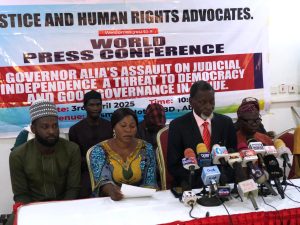
3. Disregard for Court Orders:
Governor Alia’s appointment of caretaker local government chairmen, despite a National Industrial Court ruling restraining such actions, exemplifies a blatant disregard for judicial authority and the rule of law. This decision not only violates the specific court order but also contravenes established legal precedents, including a Supreme Court judgment that outlawed the dissolution of elected local government councils and the establishment of caretaker committees by state governors. The court’s ruling emphasized that local government councils should be managed by democratically elected officials, rendering the appointment of caretaker committees unconstitutional. By proceeding with these appointments, Governor Alia undermines the judiciary’s role in upholding constitutional governance and sets a concerning precedent for the erosion of democratic principles in the state.
4. Attempted Unconstitutional Removal of the Chief Judge:
In collaboration with the Benue State House of Assembly, Governor Hyacinth Alia sought to remove Chief Judge Maurice Ikpambese over fictitious allegations of misconduct. This move was condemned by the Nigerian Bar Association (NBA), Nigeria Judicial Council (NJC), Civil Society Organisation, Prominent legal luminaries, Individuals and groups, that the act is unconstitutional, emphasizing that only the National Judicial Council (NJC) holds the authority for such actions. The NBA highlighted that any deviation from the constitutionally mandated process poses a significant threat to judicial independence and the rule of law. Furthermore, the NBA called upon all elected officials to desist from arbitrary and unconstitutional actions that jeopardize the sanctity of the judiciary. They also urged law enforcement agencies to ensure that Justice Ikpambese is not prevented from discharging his duties, emphasizing the imperative to protect judicial officers from any form of harassment or intimidation.
5. Non-Payment of Judiciary Staff Salaries Leading to Prolonged Strikes:
The failure to pay judiciary staff salaries has resulted in prolonged strikes, effectively paralyzing judicial activities in the state and denying citizens their right to timely justice. Despite the government’s announcement of a new ₦75,000 minimum wage, judiciary workers were excluded from this implementation, leading to further discontent. The government’s inability to resolve these salary disputes not only hampers the judiciary’s functionality but also erodes public trust in the state’s commitment to uphold the rule of law.
6. Mobilization of Thugs to Intimidate the Judiciary:
Reports have emerged alleging that Governor Alia sponsored thugs to protest against the Chief Justice of Nigeria in Abuja, bearing banners with despicable inscriptions. These actions are perceived as attempts to intimidate the judiciary and obstruct the course of justice, raising concerns about the erosion of judicial independence in Benue State. Such tactics represent a direct assault on democratic principles and the rule of law. The alleged orchestration of these protests underscores a troubling pattern of executive interference in judicial matters. It is imperative for the preservation of democracy that the judiciary remains free from coercion and undue influence.
7. Interference with the Legislative Arm:
Governor Alia’s interference with the legislative arm is evident through his influence over the selection of principal officers and the alleged sponsorship of the suspension of 13 assembly members who opposed the removal of the Chief Judge.This suspension, deemed unconstitutional by legal experts, undermines legislative independence. Additionally, the closure of the legislative complex, forcing sessions to convene under executive oversight, further compromises the separation of powers essential for democratic governance.
8. Attempted Bribery of the National Judicial Council (NJC):
Allegations have surfaced regarding attempts to bribe the NJC with ₦500 million to influence judicial decisions. Reports indicate that certain government functionaries in Benue State allocated these funds in a bid to manipulate the outcome of proceedings related to the removal of the state’s Chief Judge, Justice Maurice Ikpambese. Such actions, represent a grave affront to the integrity of our judicial system. Same members of the NJC were treated with disregard during the swearing-in ceremony of High Court judges, where members of the National Judicial Council traveled to Benue State to attend. However, Governor Alia reportedly abandoned them after they waited the entire day, leading to some judges and lawyers remaining at the venue until the next day. This act of disrespect not only undermines the judiciary but also tarnishes the state’s reputation.
Justice and Human Rights Advocates is calling on the Economic and Financial Crimes Commission (EFCC) and the Independent Corrupt Practices and Other Related Offences Commission (ICPC) to conduct a thorough investigation into these allegations to uphold the sanctity of judicial processes.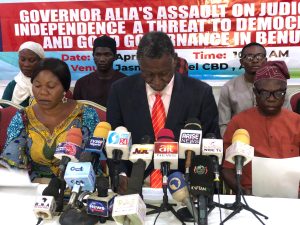
9. Blocking Court Premises with Sand:
In February 2025, reports emerged that security personnel loyal to Governor Alia, along with a local security outfit, took over the tribunal court in Makurdi. They allegedly expelled judges from the premises and poured sand at the entrance gate, erecting barricades to prevent access by tribunal judges and court officials.
10. Executive Rascality and High-Handedness:
The Alia administration has exhibited a pattern of executive overreach, including the arbitrary sealing of business premises belonging to perceived political adversaries without due legal process. Notable instances include the closure of establishments such as City Bay, Balcony, Precious events centre and Joy FM Station. Additionally, opposition figures have been subjected to unwarranted arrests and detentions, reflecting a troubling trend where thuggery is seemingly promoted over the rule of law.
11. Poor Funding of the Judiciary:
The state’s judiciary suffers from deliberate underfunding, leading to deplorable conditions within court facilities. Courtrooms are plagued by broken windows, inadequate seating for lawyers and litigants, and the absence of functional sanitation facilities, forcing individuals to resort to open defecation within court premises. Furthermore, the lack of electricity hampers judicial proceedings, and the High Court library remains outdated with obsolete research materials, undermining the judiciary’s effectiveness.
12. Invasion of the Election Petition Tribunal with Sponsored Thugs:
There have been reports of thugs allegedly sponsored by the state government invading the Election Petition Tribunal, brandishing placards with inscriptions such as “NO ALIA, NO BENUE” and “NJC AND CJN, LEAVE BENUE ALONE.” These actions are perceived as attempts to intimidate the judiciary and obstruct the course of justice, raising concerns about the erosion of judicial independence in Benue State.
These actions collectively paint a picture of anti-democratic tendencies that threaten the very fabric of governance in Benue State. The Supreme Court, in its recent judgment concerning Rivers State, highlighted that the absence of a functioning legislature equates to a lack of governance. The situation in Benue is even more dire, with both the legislative and judicial arms under siege, leading to a collapse of democratic governance.
The use of thugs against the judiciary and other institutions is particularly reprehensible. Such tactics not only intimidate judicial officers but also erode public confidence in the justice system.
The cumulative effect of these actions has plunged Benue State into a state of constant fear and apprehension. The rule of law has been supplanted by the rule of force, with thugs operating with impunity under the apparent patronage of the state government. This environment is not just reminiscent of, but indeed worse than, the darkest days of military dictatorship, where checks and balances are nonexistent, and power is concentrated in the hands of one individual.
A Call to Action:
Justice and Human Rights Advocates calls upon all democratic institutions, civil society organizations, and the international community to take immediate cognizance of the deteriorating situation in Benue State. We demand an urgent intervention to restore the sanctity of democratic governance, the independence of the judiciary, and the safety of all citizens. Governor Alia must be held accountable for his actions, and steps must be taken to ensure that the principles of democracy and the rule of law are upheld in Benue State.
Thank you.
Signed:
Dr. Emmanuel Agabi
Executive Director
For Justice and Human Rights Advocates